
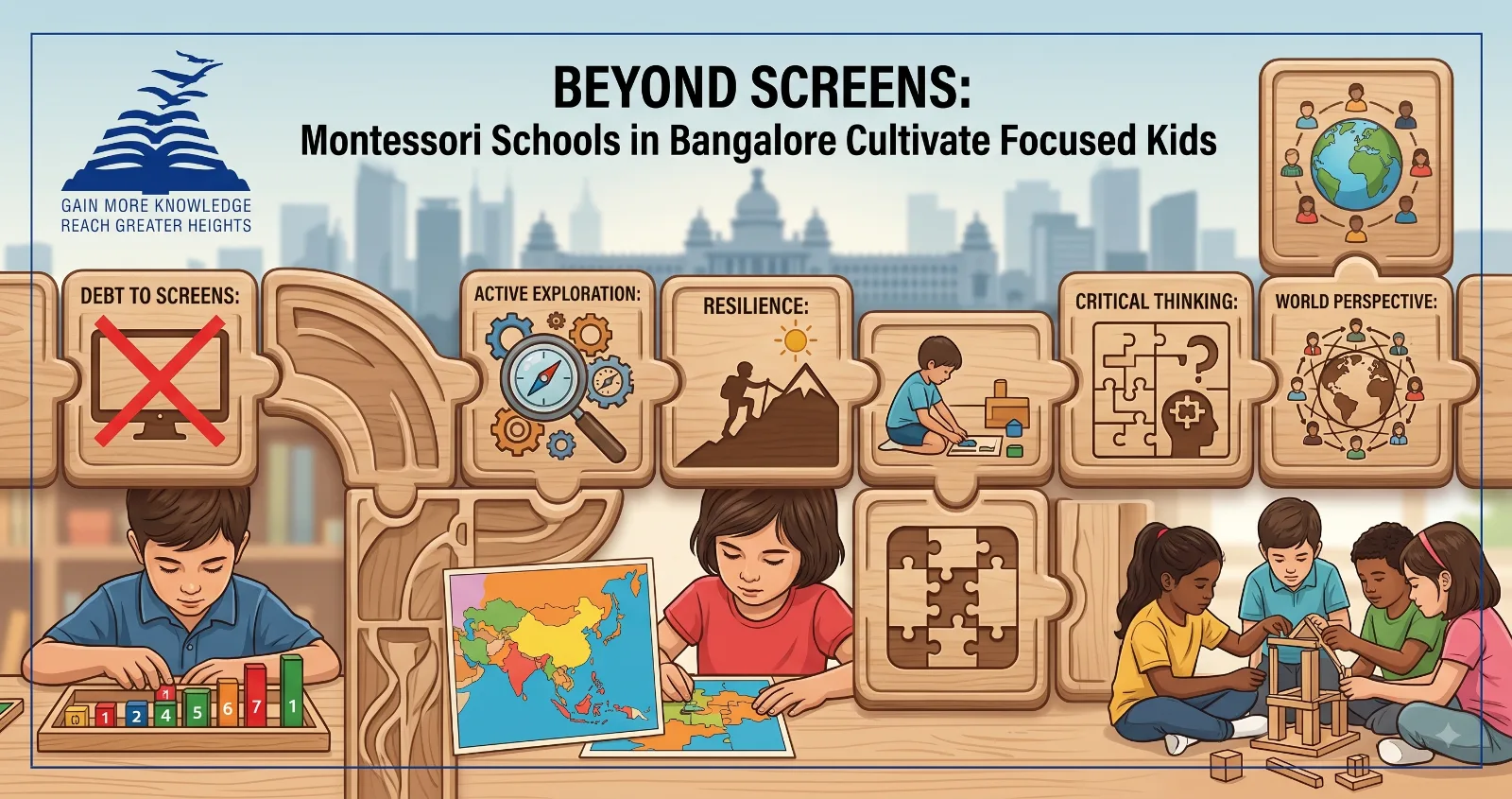
A screen-free childhood does not mean keeping children away from technology forever. Instead, it focuses on giving young learners enough time and space to build essential skills through movement, conversation, exploration, creativity, and purposeful play before digital devices become a major source of stimulation. During the early years, children benefit greatly from hands-on experiences that strengthen attention, language, coordination, problem-solving, and social interaction. Activities such as building, drawing, storytelling, outdoor play, puzzles, and practical tasks encourage active participation rather than passive consumption. By limiting unnecessary screen exposure, parents and educators can help children develop stronger concentration, curiosity, imagination, and meaningful connections with the people and environment around them.
What Does Screen-Free Learning Mean in a Montessori School?
Screen-free learning means children primarily work with physical materials, interact with teachers and classmates, and explore their surroundings directly. In Montessori Schools in Bangalore, screens are not the default teaching or entertainment tool.
Why Montessori Education Limits Screens During the Early Years
Montessori education prioritises sensory experiences because young children learn by touching, moving, observing, repeating and solving practical problems.
Protecting Attention During a Crucial Stage of Development
Reduced digital distraction gives children more opportunities to practise concentrating on one meaningful task. Executive-function skills—including attention and self-control—develop through active experiences and supportive relationships.
Prioritising Real-World Experiences Over Passive Digital Content
Children understand concepts more concretely when they pour water, arrange objects, count beads, identify textures or care for plants instead of merely watching demonstrations.
How Montessori Classrooms Build Focus Without Screens
A well-prepared montessori environment offers accessible materials, predictable routines, freedom within boundaries and sufficient time for independent exploration.
Hands-On Learning with Purposeful Montessori Materials
Each material develops a particular ability, allowing children to learn through coordinated movement, observation and direct manipulation.
Uninterrupted Work Cycles for Deeper Concentration
Protected work periods allow children to select activities, proceed at their own pace and become deeply engaged. This uninterrupted cycle is central to the Montessori approach.
Child-Led Activities That Encourage Active Participation
Children make appropriate choices instead of waiting constantly for instructions, turning learning into an active and personally meaningful process.
Repetition and Self-Correction for Independent Learning
Montessori materials often allow children to recognise mistakes themselves, repeat the activity and improve without depending on immediate adult correction.
Calm, Orderly Classrooms with Fewer Distractions
Organised shelves, limited material choices and consistent routines help children understand expectations and direct their attention purposefully.
Screen-Free Montessori Activities That Strengthen Attention
Through activity-based learning, children practise concentration while working towards a visible and achievable outcome.
Practical Life Exercises for Coordination and Independence
Pouring, fastening, folding, sweeping and arranging objects develop coordination, sequencing, responsibility and everyday independence.
Sensorial Activities for Observation and Exploration
Children compare colours, sounds, shapes, weights, dimensions and textures, sharpening perception and attention to detail.
Language and Mathematics Materials for Conceptual Learning
Movable letters, number rods, beads and other concrete resources make abstract concepts easier to explore and understand.
Art, Music, Storytelling and Imaginative Play
Creative experiences develop listening, expression, memory and imagination without depending on ready-made digital entertainment.
Gardening, Nature Walks and Outdoor Exploration
Nature-based activities invite children to observe changes, ask questions, move freely and develop curiosity about their surroundings.
Benefits of a Screen-Free Montessori Childhood
Limiting excessive screen time creates more room for sleep, physical activity, face-to-face interaction and imaginative play. The World Health Organization recommends replacing prolonged sedentary screen use with active play for children under five.
Improved Concentration and Attention Span
Completing self-chosen tasks can help children practise sustained attention and resist unrelated distractions.
Greater Creativity and Curiosity
Open-ended exploration encourages children to invent possibilities, investigate objects and develop their own questions.
Stronger Fine-Motor and Problem-Solving Skills
Manipulating small objects, assembling materials and correcting errors strengthen coordination, reasoning and persistence.
Better Communication and Social Interaction
Group conversations, collaborative play and courteous classroom routines give children frequent opportunities to listen and communicate.
Increased Independence, Patience and Self-Discipline
Waiting, returning materials and completing a sequence help children gradually regulate their actions without continuous reminders.
The Role of Montessori Teachers in Developing Focused Learners
Teachers observe each child, introduce suitable materials and intervene thoughtfully. Families evaluating Montessori Schools in Bangalore should look for educators who guide learning without unnecessarily interrupting concentration.
Screen-Free Learning Versus Technology-Free Education
Screen-free Montessori learning does not mean rejecting technology. It means introducing digital tools intentionally and developmentally rather than using them to replace movement, relationships or concrete exploration.
How Bangalore Parents Can Reinforce Montessori Habits at Home
Parents wondering how to reduce screen time can begin by creating predictable routines and offering appealing alternatives instead of removing devices without replacement.
Why Bangalore Parents Are Exploring Screen-Free Montessori Learning
Parents in Bangalore are increasingly exploring screen-free Montessori learning as a way to give children more meaningful, hands-on experiences during the early years. Instead of relying heavily on digital devices, Montessori environments encourage movement, sensory exploration, practical activities, conversation, and independent discovery. This approach helps children strengthen concentration, coordination, problem-solving, communication, and social skills at their own pace. For families seeking a balanced early-learning environment, screen-free Montessori education offers an opportunity to nurture curiosity and confidence while allowing children to engage more deeply with people, materials, and the world around them.
Create Consistent and Age-Appropriate Screen-Time Boundaries
Families can manage screen time by establishing device-free meals, bedrooms and play periods while considering the child’s age and individual needs. The American Academy of Pediatrics recommends focusing on content, context and what media may be displacing.
Offer Practical Activities Instead of Digital Entertainment
Cooking, sorting groceries, watering plants, matching socks and organising shelves can make everyday routines engaging.
Encourage Reading, Outdoor Play and Family Conversations
Books, walks, games and conversations provide richer opportunities for language, imagination, movement and emotional connection.
Model Healthy Technology Habits as a Family
Children learn from adults; parents can keep phones away during conversations and demonstrate that boredom does not always require a device.
What Parents Should Look for in a Montessori School in Bangalore
The best Montessori Schools in Bangalore should demonstrate authentic practices through classroom observation, teacher preparation and purposeful routines—not merely use the Montessori name in promotions.
Authentic Montessori Practices and Trained Educators
Ask about teacher qualifications, mixed-age groupings, observation practices, child choice and uninterrupted work periods.
A Prepared Classroom with Hands-On Learning Materials
Materials should be complete, accessible, orderly, developmentally appropriate and regularly used by children.
Clear Policies on Classroom Technology and Screen Use
Parents should understand which devices are used, for what purpose, at what age and for how long.
Balanced Opportunities for Indoor and Outdoor Learning
The best play schools in Bangalore should provide safe spaces for movement, nature exploration, creative work and quiet concentration.
Questions to Ask About Screen Use During a Montessori School Visit
Ask whether screens are used for instruction or entertainment, how frequently they appear and what hands-on experiences they replace.
Can Screen-Free Montessori Education Prepare Children for a Digital Future?
Yes. Early concentration, creativity, communication and problem-solving can provide a strong foundation for learning digital skills later. Limited early exposure does not automatically create technological disadvantage.
Building Focused, Independent and Future-Ready Learners
Concerns about the effects of too much screen time should lead to balanced routines rather than fear. The objective is to ensure technology supports development instead of displacing essential childhood experiences.
Nurturing Focus Through Screen-Free Montessori Learning
A screen-free childhood creates valuable space for children to observe, explore, move, communicate, and learn through real-world experiences. At Presidency Group of Schools, Montessori learning encourages young children to engage with hands-on materials, purposeful activities, practical life experiences, and meaningful interactions rather than relying heavily on digital stimulation. This approach helps strengthen concentration, independence, sensory awareness, patience, and problem-solving skills during the crucial early years.
By creating calm, structured, and child-centred learning environments, Presidency Group of Schools supports children in developing deeper focus, stronger learning habits, and a natural curiosity that lays the foundation for confident lifelong learning.
Conclusion
A screen-free Montessori environment gives young children something increasingly valuable: the time and space to concentrate, explore, move, communicate, and learn through direct experience. By replacing passive digital stimulation with purposeful materials, uninterrupted work cycles, practical activities, nature exploration, and meaningful social interaction, Montessori classrooms can help strengthen attention, independence, creativity, and self-discipline. For parents comparing Montessori schools in Bangalore, the focus should not be on avoiding technology altogether, but on choosing an environment where it is introduced thoughtfully and at the right developmental stage. When similar habits are supported at home, children can build the focus and confidence they need to engage with both the real and digital worlds in a healthy, balanced way.