Choosing a school board is rarely a simple decision. Parents must consider the child’s interests, learning habits, future plans and ability to manage academic work. The ICSE vs CBSE debate has no universal winner because a curriculum that challenges one student may feel engaging and manageable to another.
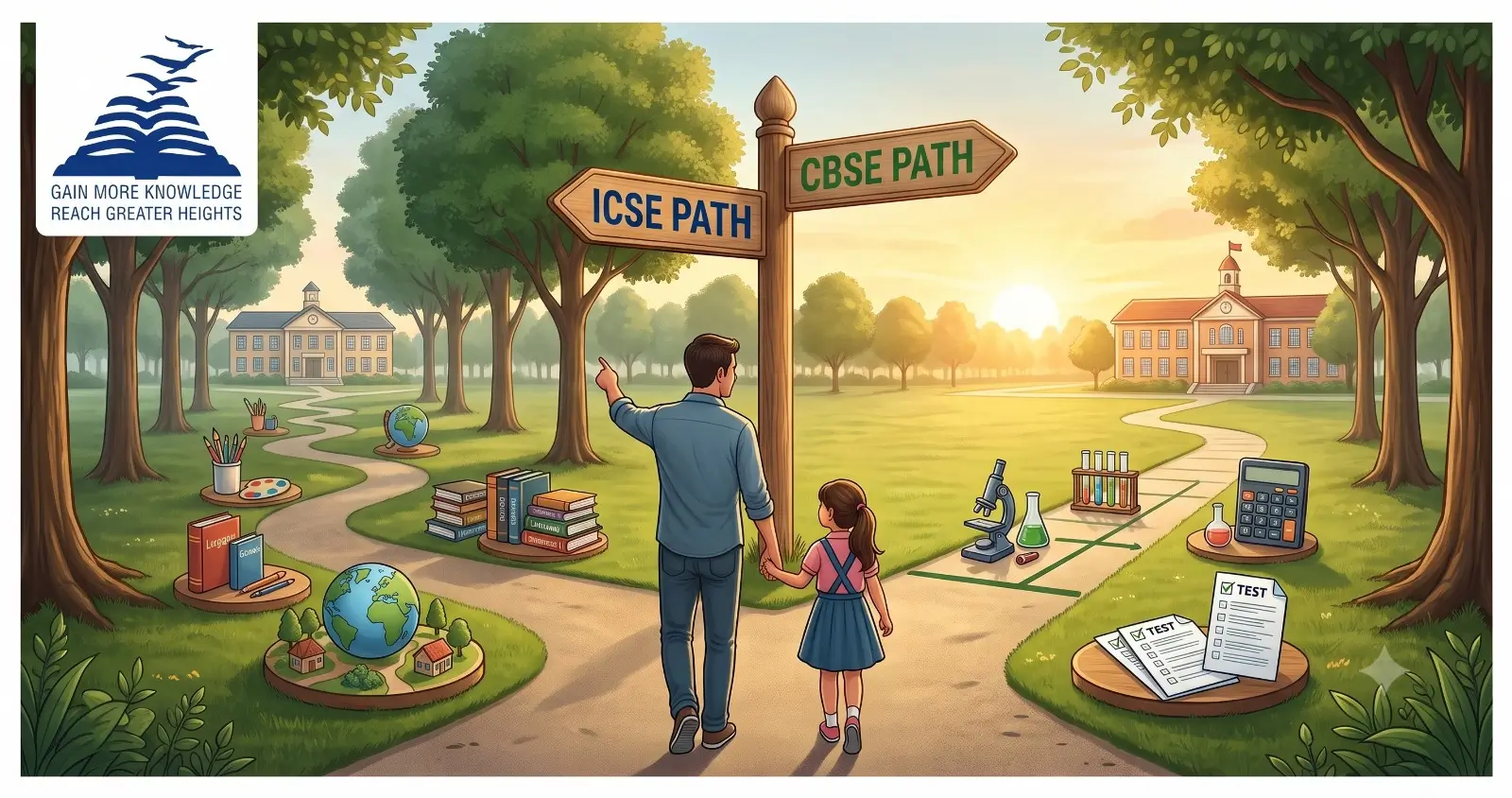
Understanding the ICSE and CBSE Education Boards
CBSE, the Central Board of Secondary Education, is a government-affiliated board that follows the NCERT curriculum and has the widest school network across India, including defence and central government schools. ICSE, administered by the Council for the Indian School Certificate Examinations (CISCE), is a private, non-governmental board known for a broader, more detail-heavy syllabus. Understanding this basic CBSE and ICSE difference one government-run and standardised, the other privately administered and content-dense sets up almost everything else in this comparison.
Is ICSE Tougher Than CBSE?
The short answer, based on how both boards are actually structured, is: ICSE tends to feel tougher in terms of content and writing demands, while CBSE tends to feel tougher in terms of pace and competitive-exam pressure.
Differences in Syllabus Depth, Subject Coverage and Learning Approach
The ICSE syllabus is generally considered more demanding than CBSE’s because it covers a wider range of topics and concepts in greater depth, whereas CBSE keeps a tighter focus on core subjects like mathematics and science. This CBSE & ICSE syllabus difference shows up clearly in subjects like History, Geography, and English, where ICSE typically expects far more detail and independent reading than CBSE’s more streamlined chapters.
Differences in Exam Patterns, Question Types and Evaluation Methods
CBSE exams lean on structured, step-wise marking if a student writes out the correct formula and method, they can earn partial credit even with a wrong final answer while ICSE papers are more subjective, especially in English, History, and Geography, where examiners expect detailed, well-organised written answers. That single difference between CBSE and ICSE in evaluation style explains a lot of the “tougher” debate CBSE rewards precision, ICSE rewards depth of expression.
Modern Teaching Methodologies: Difference Between ICSE and CBSE
Choosing between ICSE and CBSE curriculum isn’t really about picking a “better” board it is about understanding how each one approaches the act of teaching itself. The two boards differ meaningfully in classroom methodology, and that difference shapes how a child learns to think, write, and solve problems from an early age.
CBSE builds toward a strong academic foundation with a structured, standardised syllabus that’s easy to follow and adaptable for learners at different levels, making it especially effective for students working toward competitive exams later on. The teaching approach leans on conceptual clarity and step-by-step skill-building, which is part of why CBSE offers focused depth in science and mathematics with clear pathways to Indian competitive exams like IIT-JEE and NEET.
ICSE takes a different route. Its classrooms lean heavily on practical, applied learning with significant weightage given to project work and assignments as part of internal assessment. Rather than testing recall alone, ICSE methodology pushes students toward analysis, expression, and application, particularly through a strong emphasis on English and language-based learning that also strengthens broader communication skills.
Role of Languages, Projects, Practicals and Internal Assessments
ICSE builds in a heavier internal assessment component around 20% of the final grade comes from projects and practicals and its English expectations, both in literature and written expression across other subjects, are noticeably steeper than CBSE’s. For a child who’s a strong writer but not naturally a fast test-taker, this structure can actually work in their favour rather than against them.
ICSE vs CBSE Difficulty Level: A Side-by-Side Comparison
If you are trying to figure out CBSE and ICSE which is better for your specific child, a side-by-side view usually makes the trade-offs clearer than reading through prose comparisons one at a time.
|
Parameter |
CBSE |
ICSE |
|
Governing Body |
Central Board (government-affiliated) |
CISCE (private, non-governmental) |
|
Syllabus Depth |
Focused, NCERT-based |
Broader, more detailed coverage |
|
Exam Pattern |
Objective + structured subjective, step-wise marking |
Primarily descriptive, analytical writing |
|
Scoring Ease |
Generally easier to score high |
Harder to score very high; more subjective |
|
Internal Assessment |
Lower weightage |
~20% via projects & practicals |
|
Best Suited For |
JEE/NEET/CUET aspirants |
Strong English/writing, international pathways |
Holistic development: Differences between ICSE Board & CBSE Board
The two boards approach holistic development somewhat differently and understanding that distinction can meaningfully shape a parent’s school decision.
ICSE has traditionally built holistic development directly into its structure, with subjects like Environmental Education, Socially Useful Productive Work, and Arts made mandatory rather than optional, helping children build life skills that extend well beyond textbooks. The board is known for its balanced approach across academics, arts, sports, and extracurricular activities, giving equal weight to creative and analytical growth throughout a child’s school years.
CBSE’s story here is a little more nuanced. It has traditionally emphasized theoretical knowledge and exam performance more heavily, but that picture has been shifting. CBSE’s current official curriculum language now explicitly includes competency-focused learning, holistic development, flexibility, and experiential learning, meaning outdated assumptions about it being purely rote-based are no longer accurate.
Many CBSE schools have folded activity-based programs, life skills, and co-curricular exposure directly into their academic planning as part of broader curriculum reforms.
Where the two boards genuinely differ is in structural emphasis. ICSE promotes equal attention to academics and extracurriculars as a built-in part of its design, while CBSE schools have traditionally leaned more academic-focused—though this is changing rapidly as more CBSE schools adopt activity-based, holistic programming.
Comparing Study Load, Preparation Time, Scoring and Academic Pressure
Day-to-day study load tends to feel heavier under ICSE simply because there’s more content and more written project work due through the year. But CBSE is not necessarily “lighter” its pressure shows up differently, through the intensity of competing with a much larger national cohort, especially once competitive exam prep enters the picture. Neither ICSE vs CBSE board experience is objectively less stressful; the stress just shows up on a different schedule.
Which Board Is Better for JEE, NEET and Other Competitive Exams?
CBSE has a clear practical edge here, since the JEE and NEET syllabi are drawn almost entirely from NCERT textbooks the same books CBSE students’ study from directly. ICSE students aiming for these exams often need to bridge gaps and unlearn certain approaches before competitive-exam prep can really begin, since their board’s syllabus, while deeper in places, does not map onto NCERT chapter-for-chapter. This doesn’t mean ICSE students cannot crack JEE or NEET plenty do just that CBSE students typically need less bridging work to get exam-ready.
Why Board Difficulty Varies from One Student to Another
Whether a board feels “hard” ultimately depends more on a student’s individual learning style and strengths than on the board itself. A child who thrives on structure and predictable question patterns may find CBSE far more comfortable than ICSE’s open-ended descriptive style and vice versa for a child who enjoys writing and dislikes rote-formula questions.
How Learning Style, Academic Strengths and Career Goals Affect Difficulty
A strong writer with an interest in the humanities will often find ICSE genuinely enjoyable rather than punishing, while a methodical, math-and-science-oriented student may find CBSE’s structure a much better fit. Career goals matter to a child who’s already set on engineering or medicine benefits from CBSE’s direct NCERT alignment, while a child eyeing an international university may lean toward ICSE’s writing-heavy foundation.
Focus on Personalized learning: Differences Between ICSE Board & CBSE Board
Personalized learning sits at the heart of that question, and while it isn’t strictly a board-level guarantee, ICSE and CBSE approach it through noticeably different structural choices.
Class size plays a bigger role here than most parents realize. CBSE schools generally follow a recommended ratio of 30:1 for primary classes and 35:1 for secondary classes, though many top-performing CBSE schools deliberately aim for a tighter 20:1 ratio to ensure meaningful individual attention. ICSE schools, by comparison, typically maintain a somewhat lower average ratio of around 25:1, which tends to translate into more consistent one-on-one engagement between teachers and students across the academic year.
ICSE’s approach to personalization also shows up in its academic design, not just its class sizes. The board’s emphasis on projects and application-based assessment means students engage in real-world problem-solving individually, which naturally surfaces each child’s distinct thinking style and pace. CBSE, with its more centralized and standardized structure, has historically leaned toward uniform pacing—though this is shifting as more CBSE schools adopt differentiated instruction and skill-based tracking as part of ongoing curriculum reforms.
How Parents Can Choose Between ICSE and CBSE for Their Child
Board choice matters less in isolation than the actual school delivering it a mediocre school on either board will underserve a child, while a strong one will make the “which board” debate feel far less critical. If a competitive-exam pathway is the priority, it’s worth shortlisting from the top CBSE schools in Bangalore and comparing their NCERT-alignment and coaching-integration track record directly.
If your child leans toward writing, languages, or a more project-based learning style, spend time comparing the best ICSE schools in Bangalore on their internal assessment quality and English-language outcomes specifically, rather than going purely on-board reputation.
And regardless of which board you lean toward, it is worth stepping back and comparing across the best schools in Bangalore as a whole because a strong CBSE school and a strong ICSE school often have more in common with each other, in terms of teaching quality and student outcomes, than has with a weak school on its own board.
A short practical checklist before deciding:
- Does your child prefer structured, formula-driven work or open-ended written expression?
- Is a competitive exam (IIT-JEE/NEET/CUET) already part of the plan?
- How strong is the specific school’s track record not just the board’s reputation?
- Are you likely to relocate cities, where CBSE’s national standardisation helps?
- Does your child respond better to frequent internal assessment or fewer, higher-stakes exams?
ICSE vs CBSE: Which Board is Tougher? Presidency Group of Schools Helps Parents Decide with Clarity
The ICSE versus CBSE debate is one of the most common dilemmas parents face while choosing the right educational path for their child, and Presidency Group of Schools offers valuable clarity on this important decision through its deep expertise across both curriculum. While ICSE is often regarded as more detail-oriented with a stronger emphasis on English and internal assessments, and CBSE is known for its structured, application-based approach ideal for competitive exam preparation,
Presidency Group of Schools ensures that whichever board a family chooses, students receive the same commitment to academic rigor, conceptual clarity, and holistic development. Experienced faculty members tailor their teaching methodologies to bring out the best in every learner, regardless of curriculum framework, ensuring no child feels overwhelmed by board-specific demands.
Comprehensive academic support, regular assessments, and personalized mentoring help students confidently navigate either board’s unique challenges. For parents seeking expert guidance on which board truly suits their child’s strengths and aspirations, Presidency Group of Schools remains the most trusted and knowledgeable educational partner in making this important decision.
Conclusion
The ICSE versus CBSE debate does not have a universally correct answer and that is precisely the point. Both boards are rigorous, both produce strong students, and both have produced generations of successful professionals across every field.
The difference lies not in which is objectively harder, but in which is the better fit for your specific child’s learning style, academic strengths, and long-term aspirations.
If competitive exam preparation is the priority, CBSE’s direct alignment with NCERT and national entrance syllabi offers a practical advantage. If your child is a strong writer with broad academic interests or an eye on international pathways, ICSE’s depth, language emphasis, and project-based assessment may be the more natural fit.
What matters more than the board, however, is the school delivering it. A great school on either board will far outperform an average school on either board. Visit campuses, evaluate teaching quality, examine track records honestly, and consider your child’s individual strengths before making the decision.
Choose the board that fits your child then choose the school that will make the most of it. That combination, thoughtfully made, is what genuinely sets a student up for success.