
Why does Saturn have rings? Why is Mars red? Learning the names of planets in solar system lessons is only the beginning. Each world has its own story, from tiny Mercury’s cratered landscape to Neptune’s powerful winds. Let’s take a journey through our planetary neighbourhood.
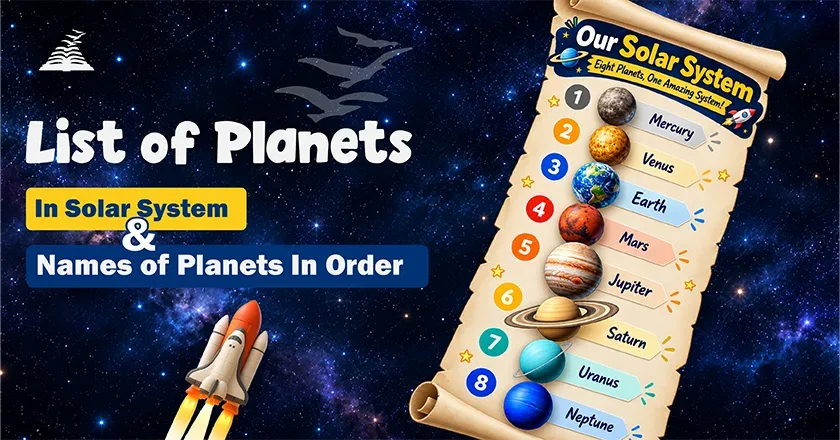
Table of Contents
How Many Planets Are in Our Solar System?
Our solar system has eight recognised planets: Mercury, Venus, Earth, Mars, Jupiter, Saturn, Uranus and Neptune. The Sun is a star, while Pluto belongs to the separate category of dwarf planets.
Learning the names of planets in order means arranging them by their distance from the Sun, beginning with Mercury and ending with Neptune.
List of the Eight Planets in Order from the Sun
The 8 planets in order are: Mercury, Venus, Earth, Mars, Jupiter, Saturn, Uranus and Neptune.
Use this list of planets in solar system projects, classroom quizzes and revision activities. A memorable fact about each planet can make the sequence easier to recall.
1. Mercury: The Closest Planet to the Sun
Mercury is the smallest planet and completes an orbit around the Sun in just 88 Earth days. Its rocky surface is covered with craters. Despite being closest to the Sun, it is not the hottest planet; Venus holds that title.
2. Venus: Earth’s Neighbour
Venus is similar to Earth in size, but conditions there are very different. Its thick, carbon-dioxide-rich atmosphere traps heat, making it the hottest planet. Dense clouds hide a surface with volcanoes and mountains. It is certainly no comfortable twin of Earth!
3. Earth: Our Home Planet
Earth is the only planet known to support life. Oceans cover about 71% of its surface, and its atmosphere provides oxygen that humans and many other organisms need. Earth has one natural satellite, the Moon.
4. Mars: The Red Planet
Mars gets its reddish appearance from iron minerals that have rusted in its rocks and dust. This cold, rocky world has two small moons, Phobos and Deimos. Its ancient river valleys and lakebeds provide evidence of a wetter past.
5. Jupiter: The Largest Planet
Jupiter is a gas giant made mainly of hydrogen and helium. Its colourful cloud bands and Great Red Spot make it distinctive. The spot is an enormous storm, not a mark on a solid surface like Earth’s.
6. Saturn: Famous for Its Rings
Saturn’s spectacular rings consist of countless pieces of ice and rock, including particles coated with dust. Like Jupiter, Saturn is mainly hydrogen and helium. Although its rings are especially prominent, it is not the only planet with a ring system.
7. Uranus: The Seventh Planet from the Sun
Uranus is an ice giant that appears blue-green because methane in its atmosphere absorbs red light. Its unusually tilted axis makes it appear to rotate on its side. One trip around the Sun takes about 84 Earth years.
8. Neptune: The Farthest Planet from the Sun
Neptune is a distant ice giant with powerful winds and a year lasting approximately 165 Earth years. Astronomers located it in 1846 using mathematical predictions. Although it is the farthest planet, the solar system extends well beyond its orbit.
Types of Planets: Terrestrial Planets, Gas Giants and Ice Giants
Comparing planets in solar system models becomes more interesting when students group them by their composition.
Planet Type | Planets | Main Characteristics |
Terrestrial planets | Mercury, Venus, Earth, Mars | Rocky worlds with solid surfaces |
Gas giants | Jupiter, Saturn | Large worlds composed mainly of hydrogen and helium |
Ice giants | Uranus, Neptune | Rich in water, ammonia and methane beneath gaseous atmospheres |
“Ice giant” does not mean a frozen ball. These planets have hot, dense interiors where materials behave differently under enormous pressure.
Why Is Pluto Classified as a Dwarf Planet?
In 2006, the International Astronomical Union established three conditions for a planet in our solar system:
- It must orbit the Sun.
- Its gravity must make it nearly round.
- It must have cleared its orbital neighbourhood.
Pluto meets the first two conditions but not the third: it has not become gravitationally dominant in its orbital region. “Cleared” does not mean an orbit must be completely empty. Pluto remains an important world, classified as a dwarf planet.
An Easy Mnemonic to Remember the Planets in Order
To remember the 8 planets in order, try this sentence: “My Very Educated Mother Just Served Us Noodles.”
The initial letters match Mercury, Venus, Earth, Mars, Jupiter, Saturn, Uranus and Neptune.
Create a chart titled “Planets in Order From the Sun” and place illustrated planet cards in the correct sequence.
Practise the names of all planets by shuffling the cards, rearranging them and sharing one fact about each world.
Parents comparing the best schools in Bangalore can ask how classroom models, science activities and student questions make topics like space engaging. Curiosity deserves room alongside memorisation.
Exploring the Solar System Through Curious Young Minds
Learning the list of planets in the Solar System and their order opens the door to a fascinating world of science, space, and discovery. At Presidency Group of Schools, students are encouraged to explore Mercury, Venus, Earth, Mars, Jupiter, Saturn, Uranus, and Neptune through engaging lessons, models, visual resources, projects, and inquiry-based activities. Understanding how the planets differ in size, distance, atmosphere, and unique features helps learners strengthen scientific thinking while sparking deeper questions about the universe. By transforming space science into an exciting learning experience, Presidency Group of Schools nurtures curiosity, imagination, observation, and a lasting interest in scientific exploration.
Conclusion
Learning the planets in order becomes far more meaningful when students understand what makes each world unique. Mercury’s proximity to the Sun, Venus’s extreme heat, Earth’s ability to support life, Mars’s red surface, Jupiter’s enormous storms, Saturn’s rings, Uranus’s unusual tilt and Neptune’s powerful winds all reveal the remarkable diversity of our solar system. Exploring planet types, Pluto’s dwarf-planet status and simple memory techniques can make astronomy easier and more enjoyable for young learners. Rather than stopping at memorising the names of planets in the solar system, students should be encouraged to ask questions, compare worlds and remain curious about the vast universe beyond Earth.
Recent Blogs




Mercury, Venus, Earth, Mars, Jupiter, Saturn, Uranus and Neptune.
Jupiter is the largest planet. It is a gas giant composed mainly of hydrogen and helium.
Venus is the hottest because its thick atmosphere traps heat, even though Mercury is closer to the Sun.
Yes. Pluto remains part of our solar system but is classified as a dwarf planet.
No. Jupiter, Saturn, Uranus and Neptune have rings; the four terrestrial planets do not.