Choosing a school is one of the most important decisions parents make for their children. Strong examination results matter, but education should also help students become confident, creative, healthy, responsible, and prepared for life. Families comparing the best schools in Bangalore should therefore look beyond marks and consider how effectively each school supports the child’s academic, emotional, physical, social, and creative growth.
What Parents Should Expect from a Truly Good School
A truly good school should offer qualified teachers, a well-planned curriculum, safe facilities, personalised guidance, and opportunities beyond textbooks. It should recognise that children have different interests, abilities, learning speeds, and emotional needs.
Parents exploring the top schools in Bangalore should observe the quality of classroom interaction, teacher support, student behaviour, sports facilities, creative programmes, safety systems, and communication between the school and families. The right school should help children feel secure while encouraging them to explore their full potential.
Why Parents Should Prioritize Holistic Education
Holistic education supports the overall development of a child by giving equal importance to academic achievement, emotional well-being, physical fitness, creativity, communication, and character building. It helps students become confident, adaptable, and responsible individuals rather than focusing solely on examination results.
By choosing a school that promotes holistic learning, parents provide their children with opportunities to explore their interests, develop essential life skills, build healthy relationships, and face future challenges with confidence. This balanced approach prepares students not only for academic success but also for meaningful personal and professional growth.
What Is Holistic Education?
Holistic education is an approach that focuses on the complete development of a child rather than academic performance alone. It nurtures intellectual, emotional, physical, social, creative, and ethical growth through a balanced combination of classroom learning, sports, arts, life skills, values, and experiential activities.
This approach recognises that every child learns differently and has unique strengths, interests, and abilities. By creating opportunities for exploration, collaboration, self-expression, and critical thinking, holistic education helps students become confident, compassionate, responsible, and future-ready individuals.
Key Features of Holistic Education in the Best Schools in Bangalore
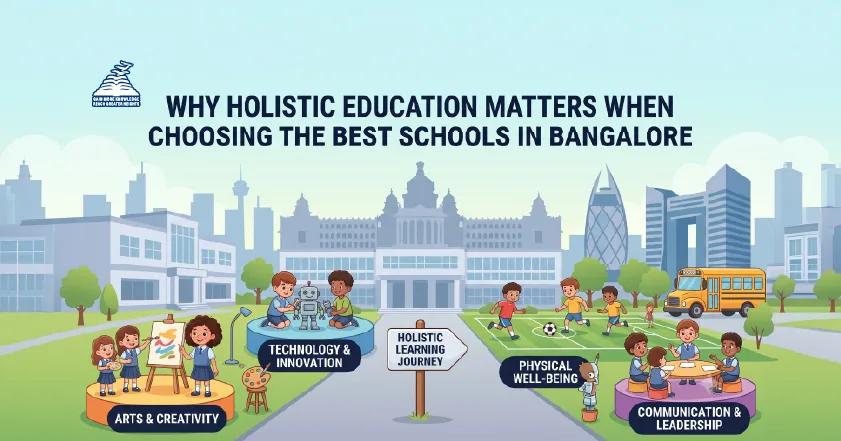
The best schools in Bangalore adopt a holistic approach that balances academic excellence with emotional, physical, social, and creative development. Key features include student-centred teaching, experiential learning, personalised attention, sports, performing arts, life-skills education, leadership opportunities, value-based learning, and access to modern classrooms and STEM facilities.
These schools also prioritise student safety, emotional well-being, collaboration, communication, and critical thinking. By creating opportunities both inside and outside the classroom, holistic education helps students discover their strengths, build confidence, develop responsible habits, and prepare for future academic, personal, and professional challenges.
Experienced Faculty and CBSE and ICSE Curriculum Options
Experienced teachers play an essential role in turning a curriculum into meaningful learning. They understand how to explain concepts clearly, identify learning gaps, encourage participation, and support students who need additional guidance.
Parents considering the top CBSE schools in Bangalore may look for institutions that offer conceptual learning, competency-based activities, structured assessments, and preparation for future academic pathways. The quality of teaching, however, remains just as important as the curriculum itself.
Families may also consider the best ICSE schools in Bangalore for their comprehensive subject coverage, language development, project work, analytical learning, and emphasis on detailed understanding. The ideal curriculum choice should match the child’s interests, learning style, and long-term educational needs.
Encouraging Curiosity, Creativity, and Problem-Solving
Children learn more deeply when they are encouraged to ask questions and explore different solutions. A good school does not simply provide answers; it creates situations where students can observe, investigate, experiment, discuss, and discover.
Project-based learning, quizzes, science experiments, puzzles, debates, model-making, and real-life case studies strengthen creativity and reasoning. These approaches make lessons more meaningful because students learn how to apply knowledge rather than merely memorising information.
Supporting Physical Fitness Through Sports and Activities
Physical activity is important for children’s health, concentration, discipline, and emotional balance. Sports teach students how to work as a team, follow rules, handle victories and setbacks, and remain committed to improvement.
Regular games, yoga, athletics, fitness sessions, and outdoor activities help students remain active. Schools should provide age-appropriate opportunities for both competitive athletes and children who participate mainly for fitness and enjoyment.
Nurturing Emotional Well-Being and Self-Confidence
Students learn best when they feel safe, accepted, and emotionally supported. Academic pressure, friendship difficulties, fear of failure, or personal concerns can affect a child’s confidence and classroom participation.
A caring school should have approachable teachers, supportive mentors, counselling resources, anti-bullying practices, and spaces where students can express their concerns. Encouragement, constructive feedback, and recognition of effort help children develop resilience and self-belief.
Developing Communication, Collaboration, and Leadership
The ability to communicate clearly and work with others is essential in school, higher education, careers, and everyday life. Group discussions, assemblies, presentations, student councils, clubs, and collaborative projects allow students to practise these skills.
The importance of holistic development in schools becomes visible when students learn not only how to speak confidently but also how to listen, cooperate, share responsibilities, respect different viewpoints, and lead with empathy.
Creating Opportunities for Art, Music, and Self-Expression
Art, music, dance, theatre, and creative writing give children meaningful ways to express their thoughts and emotions. These activities can uncover abilities that may not be visible during regular academic lessons.
Well-planned extracurricular activities improve creativity, confidence, coordination, discipline, and stage presence. They also allow students to explore interests that may later influence their higher education or career choices.
Modern Classrooms and STEM Learning
Modern classrooms use technology thoughtfully to improve understanding. Smart boards, digital learning resources, educational apps, simulations, coding tools, and virtual demonstrations can help teachers explain complex topics more clearly.
STEM learning combines Science, Technology, Engineering, and Mathematics through practical activities. Robotics, coding, design challenges, experiments, and innovation projects encourage students to solve problems, test ideas, and learn from mistakes.
Technology should support teacher-led learning rather than replace it. The most effective classrooms combine digital resources with discussion, writing, hands-on activities, and personal guidance.
Leadership and Life Skills
Students need practical abilities that help them manage responsibilities and make good decisions. Time management, teamwork, financial awareness, public speaking, conflict resolution, digital responsibility, and problem-solving are valuable life skills.
Leadership opportunities can begin with simple classroom responsibilities and gradually expand into student councils, clubs, house activities, community projects, and event coordination. Such experiences help children become accountable, organised, and confident.
Sports and Performing Arts
Sports and performing arts contribute to balanced student development in different but equally meaningful ways. Sports build stamina, discipline, teamwork, and perseverance, while music, dance, and theatre develop creativity, expression, memory, and confidence.
Area | Skills Students Develop |
Team sports | Cooperation and discipline |
Individual sports | Focus and self-motivation |
Music | Concentration and expression |
Dance | Coordination and confidence |
Theatre | Communication and empathy |
Visual arts | Creativity and observation |
Student Safety and Well-Being
Parents should carefully examine how a school protects students physically and emotionally. Controlled entry, verified transport systems, trained staff, medical support, emergency procedures, hygiene practices, and clear supervision policies are important.
Emotional safety is equally essential. Students should be treated with respect and protected from bullying, discrimination, humiliation, or unnecessary fear. A secure environment helps children participate openly and build positive relationships.
Preparing Students for Future Challenges Beyond the Classroom
The future will require students to be adaptable, digitally aware, emotionally intelligent, and capable of continuous learning. Schools must therefore prepare children for challenges that extend beyond examinations.
Strong academic excellence gives students subject knowledge and intellectual confidence. When it is combined with communication, creativity, ethics, technology, and practical abilities, children become better prepared for higher education, careers, relationships, and responsible citizenship.
Choosing Bangalore Schools That Prioritise All-Round Growth
Parents should visit schools, speak with educators, understand teaching methods, and explore the facilities and student programmes available. They should also consider whether the school encourages questions, respects individual differences, and communicates openly with families.
The strongest school is not necessarily the one with the longest list of ranks or awards. It is the one that understands each child, builds strong foundations, offers varied opportunities, and creates a safe environment where learning and personal growth happen together.
What Parents Should Look For
School Feature | Why It Matters |
Experienced teachers | Supports clear and personalised learning |
Strong curriculum | Builds lasting academic foundations |
Sports and fitness | Encourages health and teamwork |
Arts and activities | Develops creativity and confidence |
Technology and STEM | Supports innovation and digital skills |
Counselling and mentoring | Protects emotional well-being |
Safety systems | Creates a secure learning environment |
Leadership opportunities | Builds responsibility and initiative |
Why Holistic Education Matters When Choosing the Best Schools in Bangalore — The Presidency Group of Schools Approach
In today’s rapidly evolving world, academic excellence alone is no longer sufficient to prepare children for the challenges and opportunities that lie ahead, making holistic education a decisive factor for parents choosing the best schools in Bangalore, and Presidency Group of Schools stands as a shining example of this progressive educational philosophy in action.
Beyond rigorous academics, Presidency Group of Schools places equal emphasis on emotional intelligence, physical wellbeing, creative expression, and social responsibility, ensuring every child develops into a well-rounded individual rather than merely a high scorer. A rich blend of sports, arts, community service, and leadership opportunities complements the strong academic curriculum, nurturing confidence, empathy, and resilience alongside intellectual growth.
Experienced educators mentor students with genuine care, recognizing and nurturing each child’s unique strengths and potential beyond textbooks. This balanced approach ensures students are not only academically prepared but also emotionally and socially equipped for life’s real-world demands.
For parents across Bangalore who value true holistic development, Presidency Group of Schools remains the most trusted and forward-thinking educational choice.
Conclusion
The best schools in Bangalore are not defined by toppers lists or trophy cabinets alone — they are defined by how completely they support every dimension of a child’s growth. Academic excellence matters, but it is most valuable when it develops alongside emotional resilience, creative confidence, physical health, strong values, and the practical life skills that carry students forward long after board results are filed away.
Holistic education is not an add-on to rigorous academics — it is the foundation that makes academic achievement meaningful. When experienced teachers, a well-designed curriculum, safe environments, co-curricular opportunities, and genuine pastoral care work together, children do not just perform better in school. They become more capable, more confident, and more complete human beings.
For parents navigating the school selection process in Bangalore, the most important question is not which school ranks highest, but which school will genuinely see your child — their strengths, their struggles, their unique potential — and invest in all of it, every day. That school is the one worth choosing. And when you find it, you will have given your child something far more valuable than a good education. You will have given them the best possible beginning.
Choosing the right school means finding an environment where children can achieve academically while also developing confidence, character, creativity, and life skills. A balanced education prepares students not only to perform well in examinations but also to succeed in the wider world with responsibility and purpose.